
Case Study | Replacing Stitched Line-Scan Images: How INSNEX CIS Upgrades Coating Inspection
In response to the problems of "multi-camera splicing errors, complex debugging, easy to miss small defects, and high operation and maintenance costs" in wide-width coating testing of power battery electrode sheets, INSNEX has launched a coating testing solution based on LineX2 black and white CIS macro cameras. Through the "ultra-wide zero splicing, micron high-precision imaging and All-in-One integrated design", the highest 1.5m+ wide coverage is achieved, 0.05mm level defects are stably detected, and the system debugging and replacement process are greatly simplified. After the introduction of the plan, the customer defect detection rate has been increased from 99% to 99.8%, the demand for professional visual debugging manpower has been reduced by 60%, and the equipment OEE has been increased by 15%, effectively improving the detection accuracy, production efficiency and operation and maintenance efficiency of the coating production line.


01 Introduction
Power battery electrode sheet coating is the throat level core process connecting "slurry preparation" and "cell assembly" in lithium battery manufacturing. With its high precision, high speed, high stability and excellent adaptability to slurry, coating has become the industry's absolute leading solution, especially in the field of negative coating, is almost the only option. However, traditional line-scan camera solutions have long been plagued by stubborn problems such as splicing errors and complex debugging, making it difficult to meet the requirements of extreme manufacturing for inspection consistency and rapid type change.
Faced with this industry problem, one of the world's leading power battery manufacturers took the lead in seeking breakthroughs. The company's market share has ranked first in the world for many consecutive years and is the absolute leader in the field of electric vehicle batteries. Together with INSNEX, it innovatively introduced the CIS macro testing solution. With "zero splicing, high precision, and fast deployment" as the core, the two parties jointly reconstructed the new paradigm of coating testing and created a reusable benchmark for the closed loop of lithium battery manufacturing quality. path.
02 Customer Pain Points and Challenges
Wide coating is a core process in the production of power battery electrode sheets. Whether the upper and lower surfaces of the coating are misaligned and uniform directly affects battery safety and performance. At the same time, ultra-thin foils are prone to wrinkling and breaking bands during high-speed operation, and surface defects such as electrode sheet cracking may also be caused during the drying process. These defects must be stably detected by 100%, otherwise once they flow into subsequent processes, they will bring major safety hazards.
To meet a 0.04mm pixel resolution requirement across a wide 1000mm-1500mm field of view, conventional line-scan systems must stitch images from multiple 16K cameras and lenses. In practice, this approach creates four major challenges:
1. Camera splicing errors are difficult to eliminate
Multi-camera calibration is complex, and misalignment is easy to occur at the image splicing, which directly affects the measurement accuracy of the misalignment values of the front and back double coating areas, and then interferes with the correction accuracy of the coating machine PLC. In this case, MSA (Measurement System Analysis) is difficult to pass.
2. Long debugging cycle, high downtime costs
After the equipment is installed, parameters such as installation height, focus position, light source illumination angle and overlap with camera sensor need to be repeatedly adjusted. Every debugging means that the production line is shut down, and the cost is extremely high.
3. There is a risk of missing detection of "zero-tolerance" defects such as missed coating and foreign matter
Line-scan cameras have large distortion at image edges. For missing coating or foreign matter defects of 0.05mm level, edge distortion will cause the defect size to be "pseudo-reduced" or even completely unable to be presented, posing a serious risk of missing detection.
4. The "hidden cost" of multi-camera systems remains high
The system configuration highly relies on on-site fine tuning by professional engineers who are proficient in vision, and it is difficult for ordinary customer service engineers to complete it independently. In addition, when the production line cuts, pulls and replaces electrode sheets with different widths, the installation height needs to be readjusted and calibrated again, which places extremely high technical requirements on post-maintenance personnel and significantly increases long-term operating costs.
03 Solutions
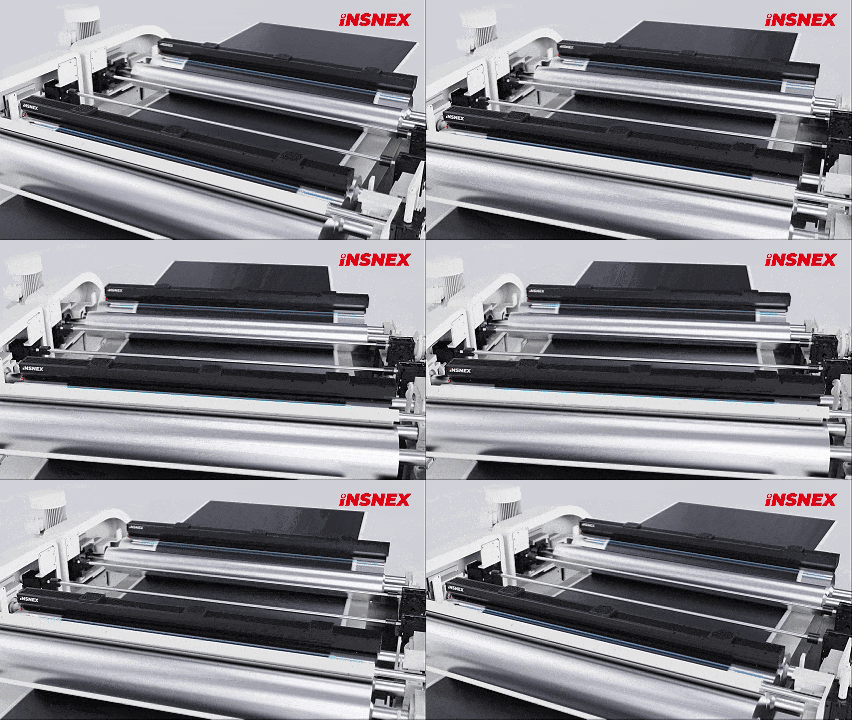
In response to this customer's urgent needs in upgrading the coating process, INSNEX innovatively launched the high-resolution LineX2 black and white CIS inspection system, which accurately solves the four-dimensional problems of traditional wire scanning solutions with three major technological breakthroughs:
1. Wide coverage "zero splicing"-completely eliminate splicing errors
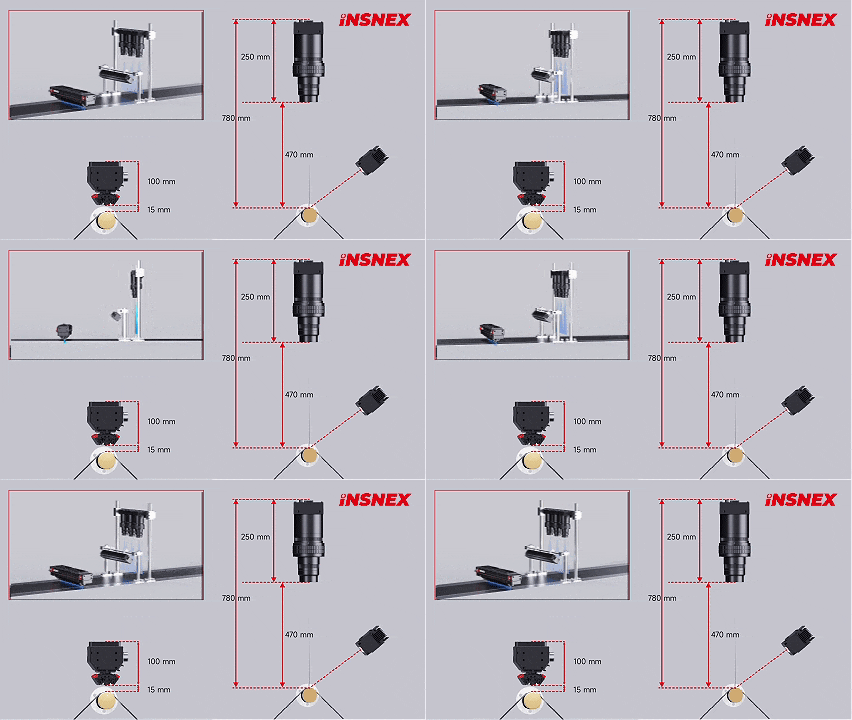
Using macro optical system, a single camera can cover ultra-wide coating surfaces (up to 1.5m+), without the need for multiple camera combinations;
Completely eliminate the multi-camera calibration process, and image collection is "formed at one time" to eliminate splicing misplacement from the source;
Achieve high-precision A/B surface visual correction, provide stable and reliable misalignment value data for the coating machine PLC, and help MSA pass smoothly.
2. Micron level high-precision imaging-zero tolerance for defects nowhere to hide
Equipped with an 600dpi (900 1200 1800dpi optional) high-resolution CMOS sensor, combined with a macro lens, can clearly identify μm level coating particles, scratches and folds;
Completely bid farewell to the risk of missing pinholes and foreign matter caused by vibration of line-scan cameras or lens edge distortion, and achieve stable detection of 0.05mm level defects.
3.All-in-One Integrated design--shortened debugging cycle 70%
Preset the light source, lens, camera, and focusing mechanism into one, use it out of the box, and support one-click calibration;
Intelligent algorithm adapts to different substrate (copper foil/aluminum foil) and paste characteristics, and improves replacement efficiency by 50%;
Significantly reduce the reliance on professional vision engineers, and ordinary customer service engineers can easily complete configuration and maintenance.
04 Customer Benefit
After introducing the INSNEX CIS solution, customers have achieved three major improvements in coating correction and testing:
1. Yield improvement
The defect detection rate has increased from 99% to 99.8%, reducing potential quality losses by tens of millions of yuan annually;
2. Cost Reduction of Operation and Maintenance
The human demand for professional visual debugging is reduced by 60%;
3. Efficiency improvement
The comprehensive efficiency of equipment (OEE) is increased by 15 %.
05 Customer Reviews
"The INSNEX macro solution solves the 'long-standing' problem of wide-width detection. It can achieve full-format high-precision imaging without splicing, helping us shorten the climbing cycle of new production lines and become a key starting point for process upgrades."
--Customer coating process leader

06 About Us

INSNEX was established in 2017. It has long been deeply involved in visual inspection scenarios. Relying on its profound industry application accumulation, it has continuously explored and iterated advanced imaging products that [make defects clearer] and the "Vision+AI" platform software to continuously explore technologies and products with better experience in the field of defect detection. LineXThe series of near-field line-scan cameras (NFL) are All-In-One imaging solutions built by INSNEX for compact spaces. LineXThe camera has the advantages of high integration, small size, and extremely low distortion, which solves the problem of multi-machine splicing and makes clear imaging easier. Another "Vision+AI" platform software product paired with INSNEXInsWorks can easily handle the development and deployment of complex inspection systems and comprehensively improve the accuracy and stability of defect detection.
At present, INSNEX products have been widely deployed in industrial fields such as lithium batteries, printing, PCB, semiconductors, 3D printing. Agents cover multiple regions around the world and gather a group of senior technical partner resources to provide localized services to customers in various regions, making line-scan imaging and defect detection systems within easy reach.

Scan the code to add customer service WeChat